
Eye Movement Desensitization and Reprocessing (EMDR) is a therapeutic method designed to uncover and dismantle the negative thoughts and beliefs deeply linked to past trauma. It targets the neurological ways you react to stress, allowing you to re-store traumatic memories in a healthier, more adaptive way.
EMDR & Hypnotherapy
There is a way for us to update our emotional brain. Trauma stops the story in the worst possible place, and Hypnotherapy or EMDR allow us to update the story and end it in a positive place to increase healing.
Trauma is something that many people experience during their lives, and it is important to know that there are effective ways to process and re-store the trauma to learn new ways to cope with and manage your reaction to it.
In our practice, we have experienced therapists who are trained in hypnotherapy and EMDR therapy, two practices that work to replace unwanted thoughts, feelings, or emotions with healthier ones for lasting change in your mental and emotional state. Both are powerful, effective tools for healing, but they work differently for different individuals so choosing which method to use will be up to you and your therapist.
So, how are they different?
Hypnotherapy
Hypnotherapy is a technique that a trained therapist will use to create a relaxed state of consciousness to guide you through inner experiences of trauma to release the emotionality of the trauma. There are many different methods used in hypnotherapy.
One method is memory reconsolidation, where you will tell the story in a new way, seeing it from an alternate perspective, and redefining beliefs about yourself or your role in relation to the experience. Doing this work via hypnotherapy increases your ability to visualize the story and use your full sensory experience to reconsolidate the event.
So, how does memory reconsolidation work? Over the course of several sessions with your therapist, you’ll work through the following steps. First, you will briefly recall the traumatic memory. Your therapist will help you to pull it out of storage without too much emotional effort. Next, you’ll explore the embodied beliefs attached to the event. For example, you may ask these questions: “What did it feel like it meant to you?” or “What did it feel like it meant about others involved?”
By looking at these beliefs in a relaxed, yet focused state, you are able to decrease the impact the trauma has had on your day to day living. Going through this process with a trained therapist keeps the trauma from becoming too big or too scary. You will maintain a level of consciousness during each session, but can hold the trauma with a light hand and maintain distance from troubling emotions around it.
EMDR
Eye Movement Desensitization and Reprocessing (EMDR) is a way to uncover and dismantle the negative thoughts and beliefs associated with trauma such that, over time, the trauma will be re-stored in a more healthy and adaptive way. This process targets the neurological ways you react to chronic stress and trauma and consequently, healing occurs on a very fundamental level.
How does this work? Since EMDR is working to re-store traumatic memories in the brain, it helps to understand how your brain stores information. The right side of the brain is more likely to hold negative emotions and perceptions and the left side typically stores positive emotions. Neural networks cross back and forth between the left and right sides of the brain, making connections between positive and negative feelings in each of your life experiences. Sometimes traumatic memories are compartmentalized in the right side of your brain and the neural networks are impaired, limiting the ability to cross over to the left (positive) side. EMDR works to build a bridge.
Initially, your therapist will guide you in focusing on resource development: you’ll envision a place of safety or a comforting person that will strengthen the neural networks associated with positive feelings. Maintaining a present mind, your therapist will then help you to recall the traumatic memory while activating bilateral eye movements, pulses, tapping, or sounds. This helps reconnect the bridge between your right and left brain. Research has found that this process reduces the vividness, and emotional intensity associated with the traumatic event.
“EMDR works best with people who are willing to dig into their past a bit and recognize some core beliefs that set the stage for how they would interpret things later in life. EMDR is good for people who feel they store stress and trauma in their bodies (muscle tension, headaches, chest tightness) and have some willingness to think about the brain-body connection.”
You will begin to feel the effects of EMDR within the first 1-2 sessions. The long term benefits take longer, usually an average of 12 sessions for a more involved trauma, but it depends on factors like your level of engagement and tolerance to the content of the memories. Some things will stay the same over the course of treatment, but some things will change and adapt as you go. You and your therapist may focus more on the body’s reaction and internalization of stress and trauma, or more on belief structures, sometimes on re-establishing feelings of safety, calm, and other strength/internal resources.
Through this process, different memories are usually brought up in the same “memory network”, and part of the process is to examine the connections and belief systems built around these memories. In this way, EMDR can be a very involved process that can bring well-rounded healing to not just a single traumatic memory, but can also the foundation the memory sits on.



If you have additional questions about either of these techniques or feel that you are ready to work with a therapist to free yourself from lasting trauma or PTSD with the use of EMDR or Hypnotherapy, give us a call at 630-563-0044 or click the link below to book online.
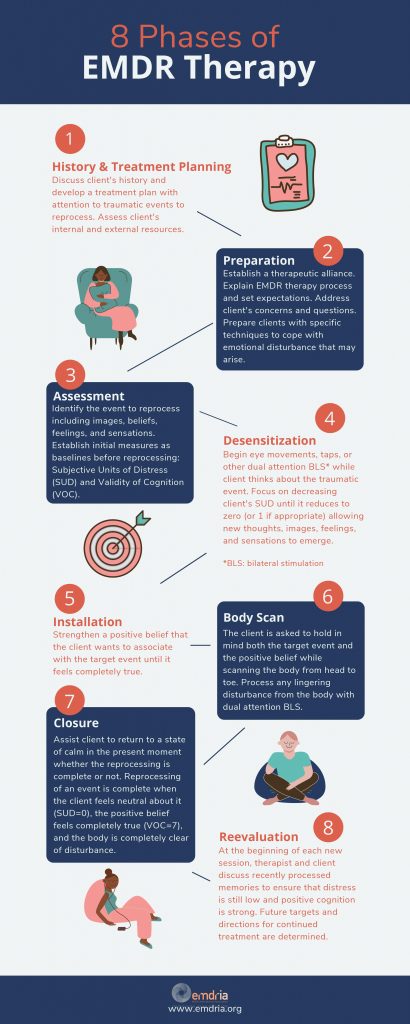
Here is a great graphic from EMDRIA explaining the 8 Phases of EMDR Therapy.
FAQs About EMDR & Hypnotherapy in Illinois
How does EMDR actually work in the brain?
Traumatic memories are often compartmentalized in the right side of the brain, separated from the positive processing capabilities of the left side. EMDR works to build a bridge between these two sides using bilateral stimulation, which allows your brain to make new connections between positive and negative feelings.
What happens during a typical EMDR session?
Your therapist will first help you focus on resource development, where you envision a safe place or comforting person to strengthen your internal resources. Then, while maintaining a sense of safety, you will recall the memory while your therapist guides you through bilateral eye movements, tapping or sounds to reduce the memory’s emotional intensity.
How quickly will I feel the effects of EMDR?
Many clients begin to feel the positive effects of this work within the first one or two sessions. While some relief can be immediate, long-term benefits for more involved trauma typically require an average of 12 sessions to ensure the healing is complete.
What does hypnotherapy involve?
Hypnotherapy is a technique where a trained therapist guides you into a relaxed state of consciousness to help you access inner experiences safely. This state allows you to release the intense emotionality of trauma while maintaining a comfortable distance from the troubling emotions.
How does hypnotherapy work to heal trauma?
One effective method used is memory reconsolidation, where you retell your trauma story from a new, safer perspective. By redefining your beliefs about yourself and your role in the experience, you can decrease the impact the trauma has on your day-to-day life.
Reviews
What Our Past Clients Have To Say



Contact Us
- Phone: 630-563-0044
- Fax: 630-914-6054
NUVEW | Copyright 2026. All Rights Reserved | Accessibility Notice | Privacy Policy